Does Grace Give Us Permission to Sin?
Grace and Sin
The tension around the topic of Grace is almost always in relation to Sin. While this is a legitimate concern, it has unfortunately taken attention away from the gravity and power of the message of Grace. The power of the Gospel is found in the message of Grace. If the message of judgment could save humanity, then the whole world would have been saved by now.
The Apostle Paul understood this tension in his own teaching, and he addressed it directly.
Romans 6:1 (KJV): “What shall we say then? Shall we continue in sin, that grace may abound?”
Romans 1–5 traces Paul’s argument from humanity’s problem to God’s solution. He begins by showing that the Gentile world is trapped in rebellion, but then turns to the religious person and makes it clear that possessing the Law does not make anyone righteous.
By Romans 3, Paul brings everyone under the same conclusion: all have sinned, and no one is made righteous by works of the Law. Instead, righteousness is given by God through faith in Jesus Christ.
Romans 4 points to Abraham as proof that this principle of faith existed long before the Law of Moses. Then Romans 5 shows the outcome of that Grace: through Christ we have peace with God. While Adam brought sin, condemnation, and death into the human story, Jesus brings righteousness, Grace, and life (Which has always been the plan).
Paul closes Romans 5 with one of the boldest statements in the entire letter:
Where sin multiplied, God’s Grace overflowed beyond it.
This is what leads to the famous question:
“Shall we continue in sin, that grace may abound?”
Continuing In Sin
The question is not simply, “Should we sin?”
Paul asks whether we should intentionally continue or remain in Sin for the purpose of increasing Grace. To put it another way; Should we make Sin our lifestyle because we know that we have been justified and that God’s Grace is greater than our sin?
Paul answers immediately: God forbid. Absolutely not. He rebuked that thought or idea.
Understanding Grace (the Nature of God) is not a license to remain under the rule of Sin. But notice how Paul answers the question. He does not simply give them another list of rules. He points them to their identity.
In Romans 6:2–14, Paul explains that we died to Sin. Not that we will die to Sin someday. Our old man was crucified with Christ. Not that he will eventually be crucified.
Something has already happened.
Through our acceptance of the death, burial, and resurrection of Jesus Christ, our relationship to Sin has fundamentally changed. Sin is no longer our rightful master.
The question is: Should someone who has been freed from the dominion of Sin deliberately choose to continue living under its authority?
The answer is found in understanding our new identity in Christ.
Shall We Sin
Paul then raises another question later in the same chapter.
Romans 6:15:“What then? Shall we sin because we are not under the law but under grace? By no means!”
The first question asks whether we should continue or remain in Sin. The second asks whether being under Grace instead of Law gives us permission to sin.
So although the questions are closely related, they are not exactly identical.
An example may help. Imagine that I hold a position at my job where I continually embezzle money. I have made dishonesty part of the way I live. Romans 6:1 confronts the idea of deliberately remaining in that kind of life because I believe Grace will continue to cover me.
Romans 6:15 raises the broader question: because I am under Grace, does that now give me permission to commit sinful acts whenever I choose? If someone offends me, can I knowingly curse them out and simply say, “I am under Grace anyway”?
Paul answers that question with the same force: Absolutely not.
And again, his answer returns to identity and freedom.
Romans 6:17–18: “But thanks be to God that, though you used to be slaves to sin, you have come to obey from your heart the pattern of teaching that has now claimed your allegiance. You have been set free from sin and have become slaves to righteousness.”
Paul does not merely say: “Try harder not to sin.”
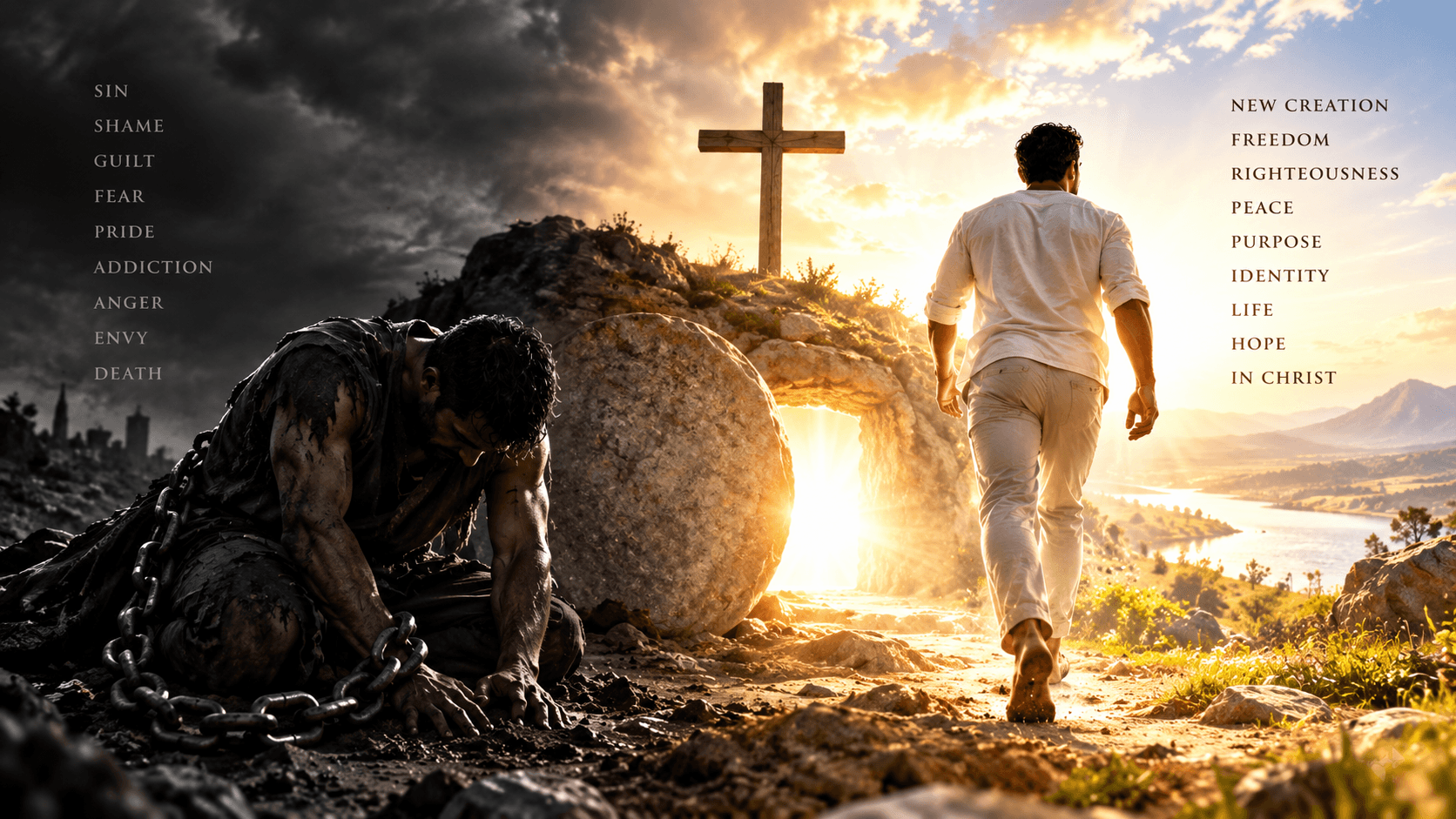
He says: You have been set free from Sin.Sin has lost its rightful claim of mastery over you. So the answer to both questions—continuing in Sin and committing sin—is found in understanding the death, burial, and resurrection of Christ. The answer is found in understanding our new identity.
The answer is found in knowing Christ more and What He has done.
To put this in simpler English; If you know who you are (Your New Nature), you will resist the human Sinful Nature.
But this has NOTHING to do with what Jesus has already done.
But What Exactly Is Sin?
Much of the debate surrounding Grace comes from a limited understanding of Sin.
If God Himself is our reference point, then Sin goes much deeper than the obvious things that we normally condemn in other people. Sin is not merely murder, adultery, homosexuality, theft, or lying etc. Sin reaches into the human heart.
Sin is a deviation from God's perfect will.
Jesus made this clear.
Mark 7:20–23:“From within, out of the heart of men, proceed evil thoughts…”
Jesus then lists sexual immorality, theft, murder, adultery, greed, wickedness, deceit, envy, pride, and other evils. Notice where He says these things originate: from within.
Jesus also said:
Matthew 5:27–28: “Whosoever looketh on a woman to lust after her hath committed adultery with her already in his heart.”
The act had not even occurred physically, yet Jesus dealt with what was already taking place in the heart. Jesus mentioned forgiveness 70 x 7 times IN A DAY. Jesus talked about turning the other cheeks when slapped.
God's standard is impossible to be met.
Scripture even treats cowardice and fear-driven unfaithfulness seriously. Revelation 21:8:
We are professionals at identifying sins in other people, especially sins that we know we ourselves are not guilty of. Matthew 7:3 (KJV)

For example, it can be very easy for someone to loudly condemn homosexuality because they are not homosexual, while at the same time being indifferent to injustice, hatred, greed, pride, cruelty, or even the suffering and killing of innocent people elsewhere in the world.
But the perfect God sees all of it. He sees outward behavior. He sees motives. He sees desires. He sees pride “(the subtle and loud ones). He sees hatred. He sees greed. He sees lust (all types of Lust). He sees indifference. He sees what is happening in the heart.
Once we truly understand the depth of Sin, human boasting becomes impossible.
The Gospel of Grace
The Gospel of Grace is the antidote. And when we speak about the Gospel of Grace, we are ultimately speaking about the revelation of Jesus Christ and His True Nature.
Grace is 100% about God, His true nature, and what He chose to do. It has nothing to do with us.
Grace is God expressing Love to us, His creation.
When Christ is revealed and received, something happens that rules could never accomplish: REBIRTH.
We become a new creation. Our old identity dies with Christ. We are raised into a new life.
The dominion of Sin is broken. And from that moment, transformation begins.
We do not transform ourselves in order to become accepted by God. We are being transformed because, through Christ, we have already been brought into a new identity and reunited with God.
Hebrews 8:12: “For I will be merciful to their unrighteousness, and their sins and their iniquities will I remember no more.”
And this was promised long before in Jeremiah:
Jeremiah 31:34: “…for I will forgive their iniquity, and I will remember their sin no more.”
To put this again in a more plain English; Jesus decided to overwhelm us with His goodness, kindness, mercy, etc regardless of what we did, are doing or will do.

In the next chapter of our series, we will go deeper by exploring Grace and The Law.