Grace Is the Truth
John 1:17 (NIV):
“For the law was given through Moses; grace and truth came through Jesus Christ.”
In the first part of this topic, we explained that grace is the character of God. God is gracious. His graciousness did not begin in the New Testament. Jesus is the same God in the Old Testament, the same God who lived among us as a man, and the same God after His resurrection.
One of the most common disclaimers attached to the teaching of grace is that grace must be balanced with truth. John 1:17 is often used to support this idea.
We believe this is a misreading of the verse.
John is not presenting truth as the restraint, correction, or balance to grace. He is doing something completely different and opposite.
The Gospel of John
In our opinion, the Gospel of John is one of the greatest books in Scripture because John does more than tell us what Jesus did. He consistently explains who Jesus is.
From the opening verse, John deliberately connects Jesus to creation:
Genesis 1:1:
“In the beginning God…”
John 1:1:
“In the beginning was the Word…”
Genesis 1:3:
“Let there be light.”
John 1:4:
“In him was life, and that life was the light of all mankind.”
John 1 is fundamentally about the identity of Jesus Christ.So when we arrive at verse 17, we should still be thinking about identity.
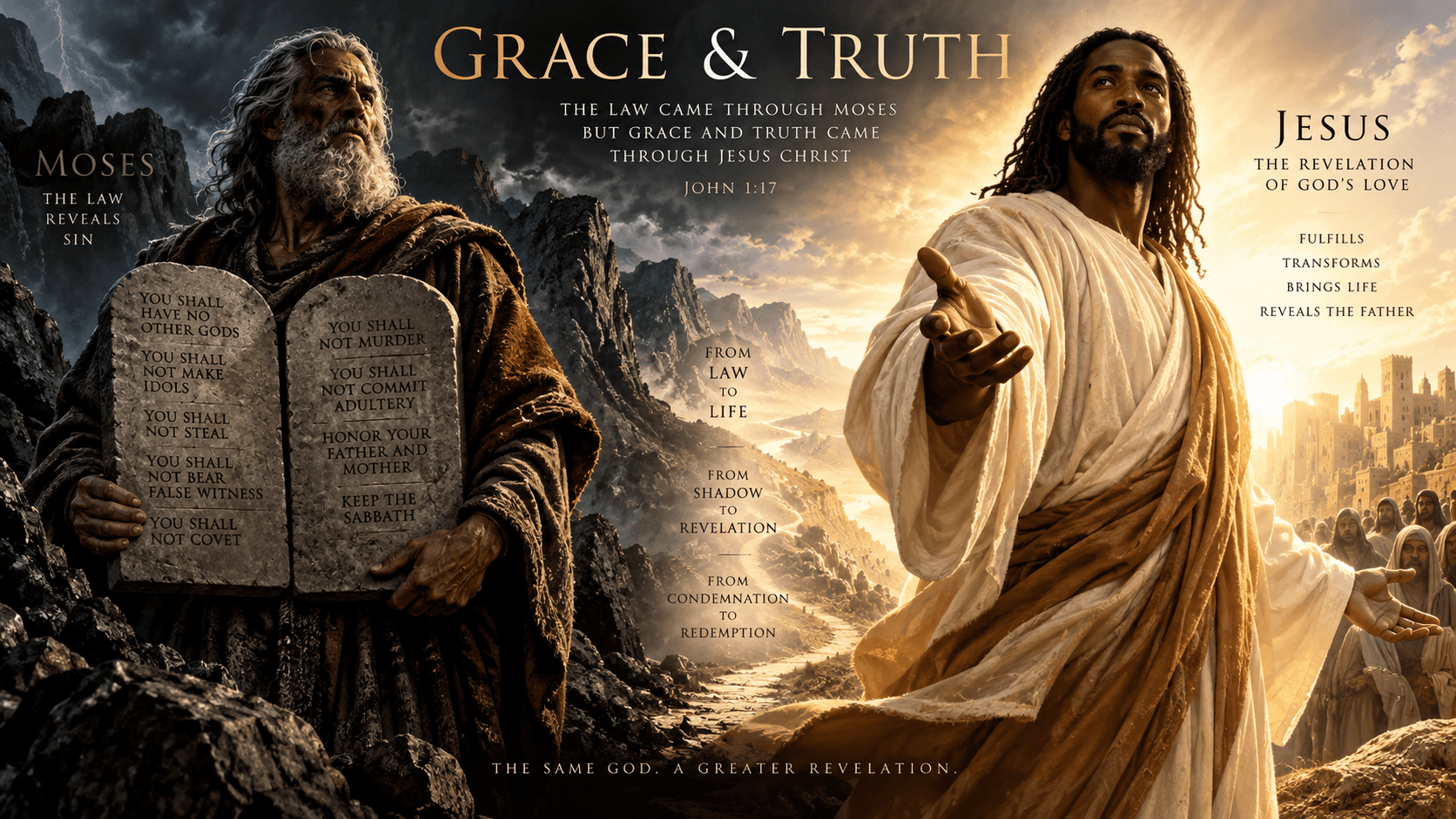
The law was given through Moses
Moses is identified with the giving of the Law. The Law came through him, and everything associated with the function of the Law came with it—including accusation and consciousness of sin.
Jesus made this point:
John 5:45–46:
“But do not think I will accuse you before the Father. Your accuser is Moses, on whom your hopes are set. If you believed Moses, you would believe me, for he wrote about me.”
The Law pointed toward Jesus, but the Law also exposed sin.
Romans 3:20 (NIV): “Through the law we become conscious of our sin.”
Romans 7:7 (NIV): “I would not have known what sin was had it not been for the law.”
This is important.
When believers say the Gospel of Grace must be balanced with “truth about sin,” they are assigning to Jesus what Scripture assigns to the Law/Moses.
Moses gives the Law. The Law exposes sin. The Law accuses.
But through Jesus come grace and truth.
So, what does John mean by “truth”?
THE TRUTH
The Greek word translated truth in John 1:17 is ἀλήθεια (alētheia). It means truth, reality, truthfulness, genuineness, or that which is revealed as it actually is.
John is not talking about “truth about your sin” in this verse. That idea does not fit the flow of John 1.
John is talking about the true revelation of God.
The entire chapter is revealing the identity of Jesus, and through Jesus, the identity of God Himself.
This becomes even clearer when we understand the figure of speech known as hendiadys.
Hendiadys
A hendiadys, or “two for one,” is a figure of speech where two words are joined by “and,” but together they express one main idea.
For example: “He spoke with power and authority.” The meaning can be:“He spoke with powerful authority.”The two words are not opposing each other. One strengthens or explains the other.
That is how we understand “grace and truth” in John 1:17. John is not presenting: Grace and Truth as two competing forces. He is describing one unified revelation:
Grace that is true. Grace that reveals real essence of God. Grace that reveals the true character of God. Truth is not standing beside grace to limit it. Truth explains what this grace is.
In Conclusion: In the Beginning Was Logos
John started the book by explaining that Jesus was the Word. The word here is not “word” as we commonly use it today. The Greek word translated as Word is Logos, which can be understood as expression or revelation.
In other words, Jesus was not God’s “errand man.” Jesus is the expression of God the Father. Jesus is the revelation of God the Father. This is why Jesus said when we see Him, we have seen the Father.

God is Spirit. No man can see Him. But God the Father revealed Himself through Jesus, who had existed before time with Him. He is God Himself.
By the time of John, Moses held an almost unrivaled place of authority in Jewish religious life. He was not regarded as God, but as the great mediator through whom God had given Israel His Law. Jesus alluded to this in John 5:45 that the Jews put their trust in Moses.
While still describing the identity of Jesus, John made a contrast between Jesus Christ and Moses in that verse 17.
Unlike Moses, Jesus is gracious—full of grace—and this is the true identity of God.
If we were to rephrase that verse, it would read:
“The law was given through Moses, but the grace, that reveals the true reality / identity of God, came through Jesus Christ.”
Or:
“Moses brought the Law; Jesus Christ revealed God’s grace as the truth of who God really is.”
Or;
“Through Moses came the Law; through Jesus Christ came the true revelation of God’s grace.”
In the Next part, we will explore the different expression of God's Grace.