Jesus: The Door of the Sheep
John 9 offers a very interesting contrast between the Pharisees’ leadership approach and Jesus’ leadership approach. In summary, Jesus healed a blind man. He spat on the ground, made mud, put it on the man’s eyes, and instructed him to wash. The blind man was healed. People were amazed at this miracle, which naturally led them to ask questions about Jesus.
The Pharisees, however, made an issue out of this. They said Jesus was “not of God” because He healed on the Sabbath. They questioned the validity of the miracle and sent for the parents of the blind man to verify it. The inquiry was so intense that John records the parents were afraid of the Jewish leaders.
They called the blind man again and tried to manipulate him by saying, “Give glory to God by telling the truth” (verse 24). When this failed, they resorted to insulting him. They aligned themselves with Moses in contrast to Jesus, claiming that God spoke to Moses, but because Jesus was a sinner, God could not have spoken to Him. What they failed to realize was that it was the very God who spoke to Moses whom they were now opposing.
The blind man pushed back against this assertion, and at that moment it became clear that the Pharisees had lost any remaining respect he had for them. They ultimately kicked him out.
After he was expelled, Jesus found him and revealed Himself as “the Son of Man.” Jesus then exposed the Pharisees as spiritually blind.
This story leads directly into the topic of this write-up:
Jesus: The Door of the Sheep
Jesus then moved into the shepherd metaphor to draw a strong contrast between Himself and the Pharisees.
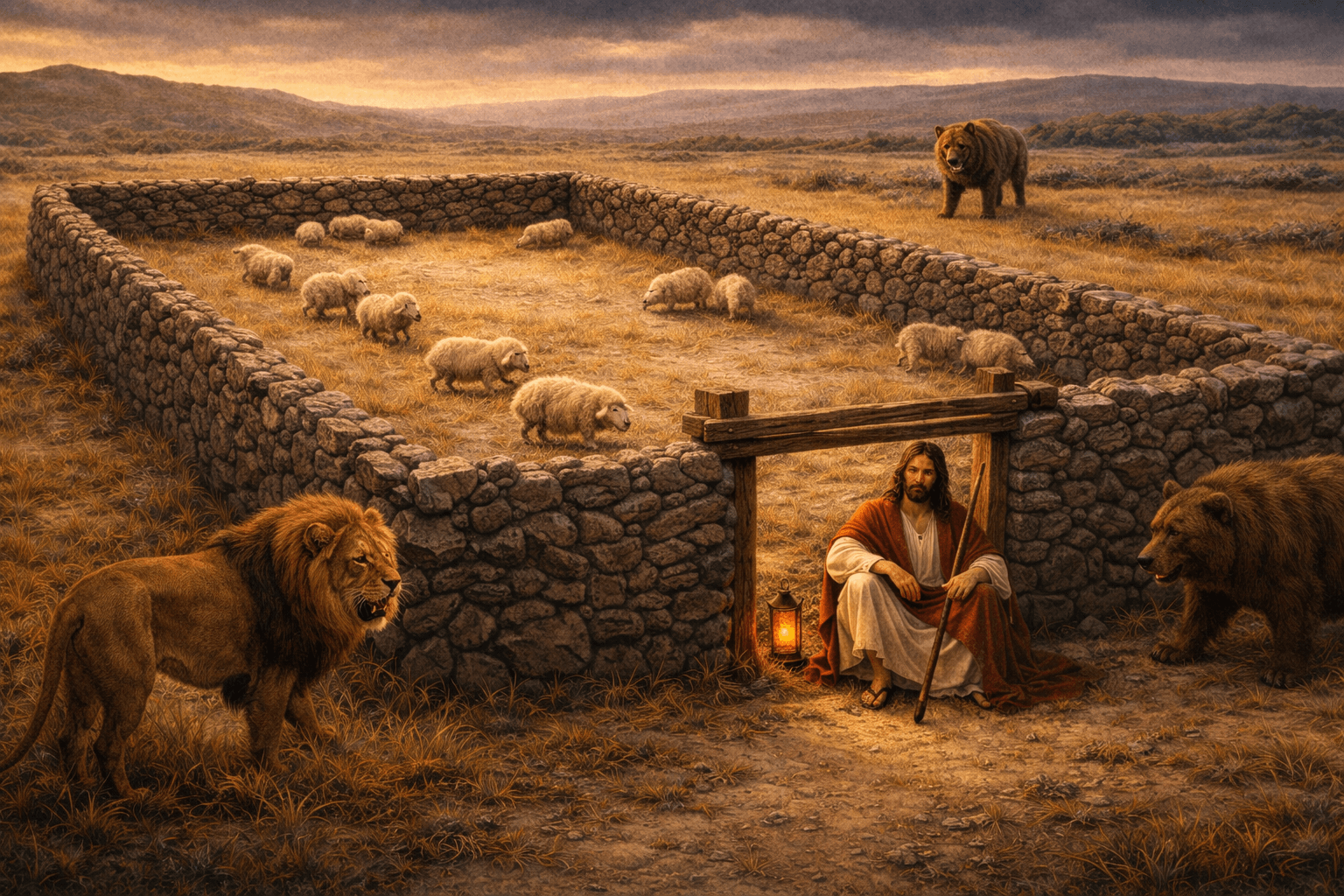
To fully understand this metaphor, it helps to visualize a sheepfold.
A sheepfold is a place of rest for the sheep and a place of protection.
Elements of a Historical Jewish Sheepfold
- Single narrow entrance (one way in, one way out)
- No physical door (the shepherd was the door)
- Shepherd lying across the entrance at night
- Shared fold (multiple flocks together overnight)
- Individual voice recognition (sheep knew their shepherd’s voice)
- Protection from thieves and predators
- Morning separation (each shepherd calls out his own sheep)
Verse 1 & 2: Jesus explains that the only way into the sheepfold is through the door. Remember, the sheepfold is a place of rest and protection. Anyone who tries to enter by climbing the wall is a thief. Jesus enters through the door.
Verse 3: The sheep know His (Jesus’) voice, and He knows the names of the sheep. He leads them.
Verse 4: Not only does He lead the sheep, but He leads from the front. This is literally the same leadership pattern God demonstrated in Exodus.
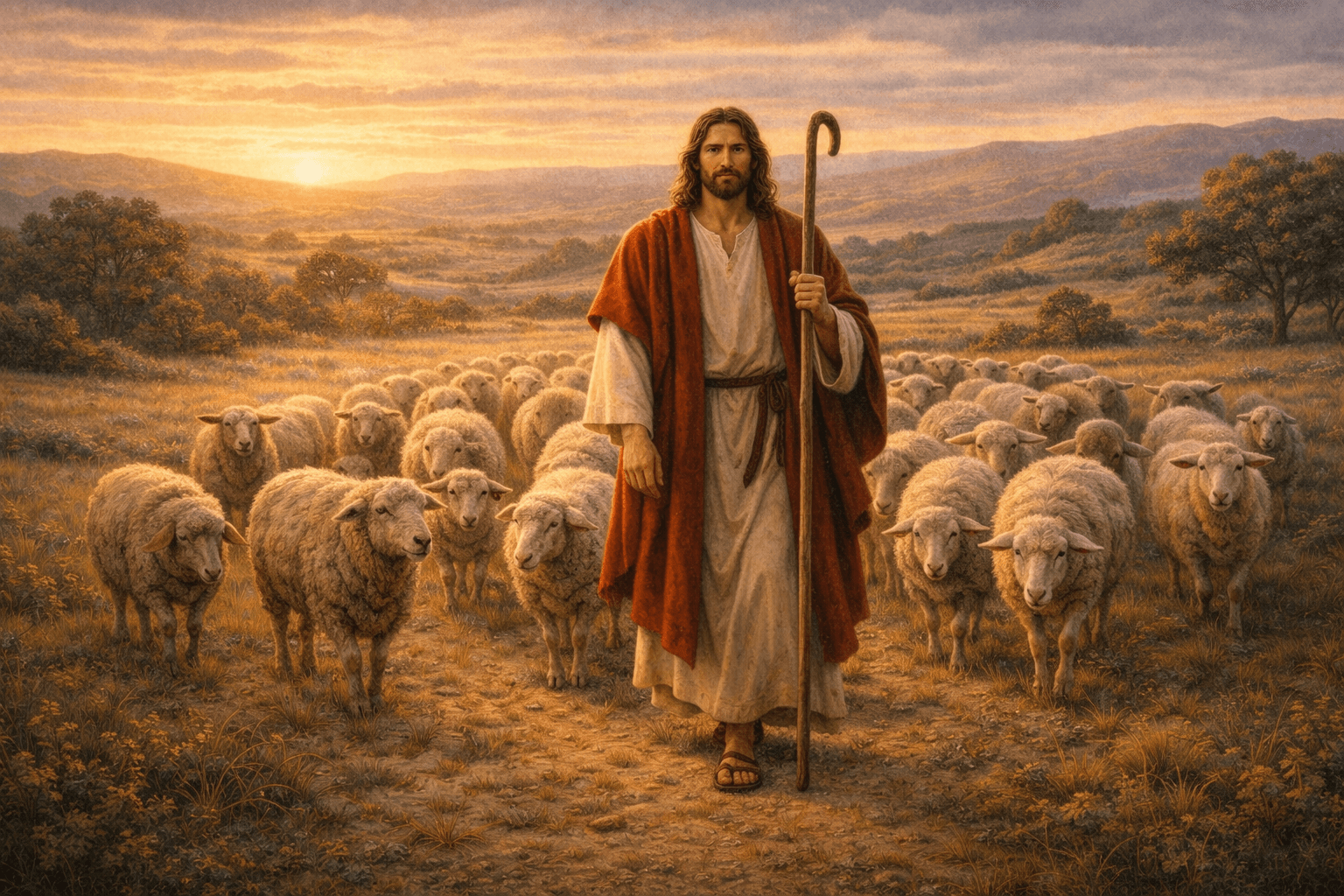
Exodus 13:21 (NIV); “By day the LORD went ahead of them in a pillar of cloud to guide them on their way and by night in a pillar of fire to give them light, so that they could travel by day or night.”
Psalm 119:105 “Your word is a lamp for my feet, a light on my path.”
Verse 7: Jesus says, “I am the door of the sheep.” This is striking because He has already identified Himself as the shepherd—so how can He now also be the door?
Historically, in Jewish culture, the shepherd would sit or lie at the entrance of the sheepfold at night. He personally protected the sheep from predators and thieves. Jesus was essentially saying that to reach the sheep, one must go through Him—because He Himself is positioned at the entrance.
This means He is the ultimate protector of the sheep.
Ezekiel 34 Connection
What Jesus was saying here had already been declared in Ezekiel 34 by Him.
“Son of man, prophesy against the shepherds of Israel…” (Ezekiel 34:2)
Sins of the Shepherds in Ezekiel 34
- They feed themselves, not the sheep
- They consume the sheep’s resources
- They fail to strengthen the weak
- They do not heal the sick
- They do not bind up the injured
- They do not bring back the strays
- They do not search for the lost
- They rule with force and harshness
- They allow the flock to be scattered
- They expose the sheep to predators
- They fail to restrain exploitation
- They do not seek God’s sheep at all
These characteristics are exactly what the Pharisees displayed in John 9. Jesus used this moment to show that Israel’s shepherds (the system) had failed, and that God Himself was now stepping in to shepherd His people.
Conclusion
Ezekiel 34:11–12 (NIV); “I myself will search for my sheep and look after them…”
As repeatedly shown throughout Scripture, the Law and the Prophets point to Jesus. Ezekiel 34 was directly prophesying about God coming among His people to establish His own priesthood, leadership and system. Humans were never the enemy of God—we are His creation. So the issue was never the individual pharisees or prophet or Priests.
Hebrews 13:20; “May the God of peace… bring back from the dead our Lord Jesus, that great Shepherd of the sheep…”
The contrast between the Good Shepherd and the bad shepherd is the contrast between the human system (the Law), which the Pharisees embodied, and God’s system (Grace). The Law cannot save. Jesus is our Good Shepherd. He is the One who came to save us, lead us, protect us, and provide for us. As the Door of the sheep, He guarantees our rest. He came to remove the veil beween us and God. There is no more need for Human shepherds & intermediary as it was in the Old System.
Ezekiel 34:15–16 (NIV); “I myself will tend my sheep and have them lie down…”
Hebrews 7:24–25; “Because Jesus lives forever, he has a permanent priesthood. Therefore he is able to save completely those who come to God through him…”