The Missing Cup: How Jesus Finished the Passover on the Cross
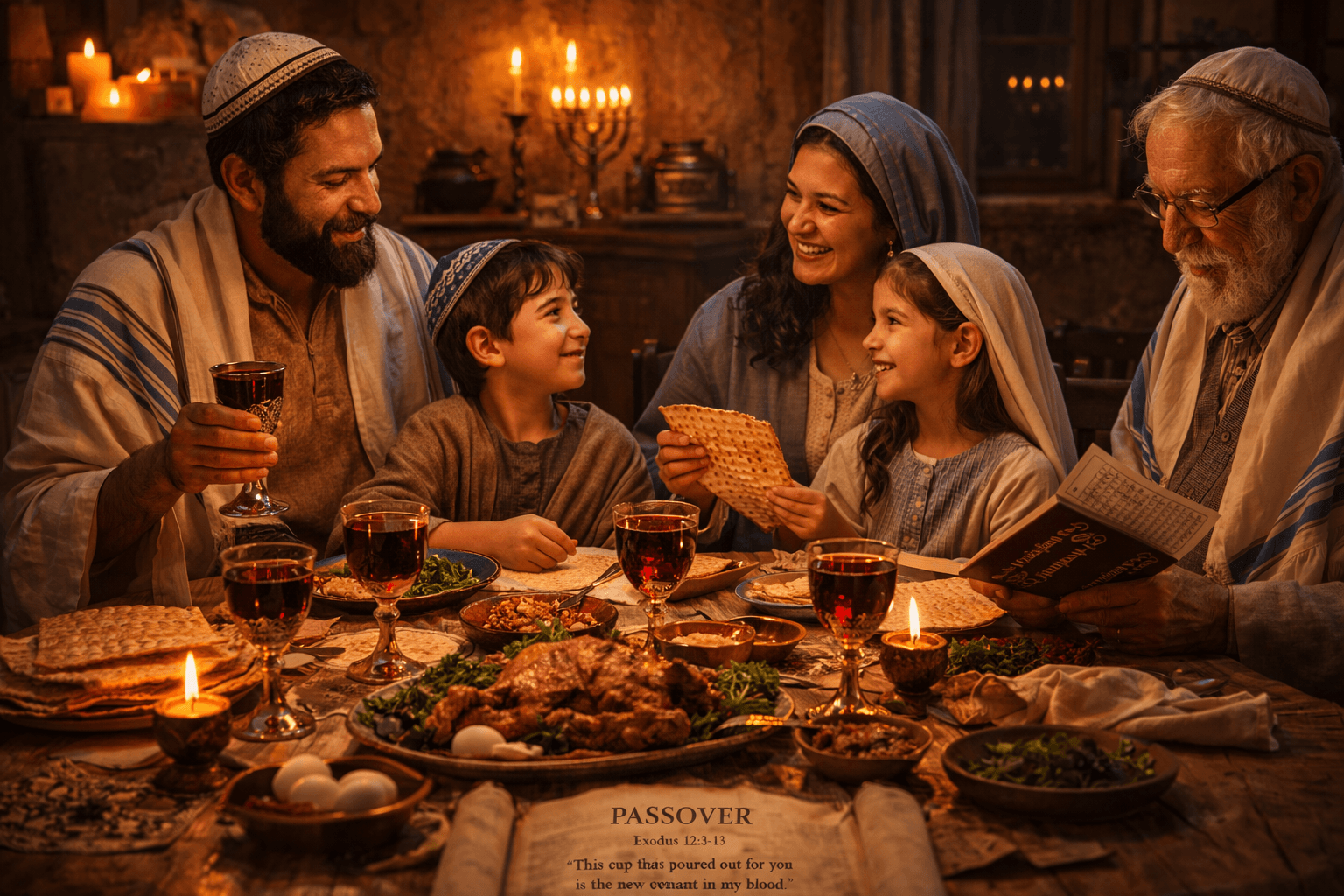
The Passover feast is a commanded observance in which the Israelites were to remember God’s deliverance from Egypt by sacrificing a lamb, applying its blood to their doorposts, and eating the roasted lamb with unleavened bread and bitter herbs on the night the Lord passed over them (Exodus 12:3–13). It was to be eaten in readiness for departure, with no leftovers remaining until morning (Exodus 12:10–11). This event was established as a lasting ordinance, to be kept annually along with the Feast of Unleavened Bread for seven days, during which no leaven was to be found in their homes (Exodus 12:14–20), and parents were to explain its meaning to future generations (Exodus 12:26–27).
The Four Passover Cups
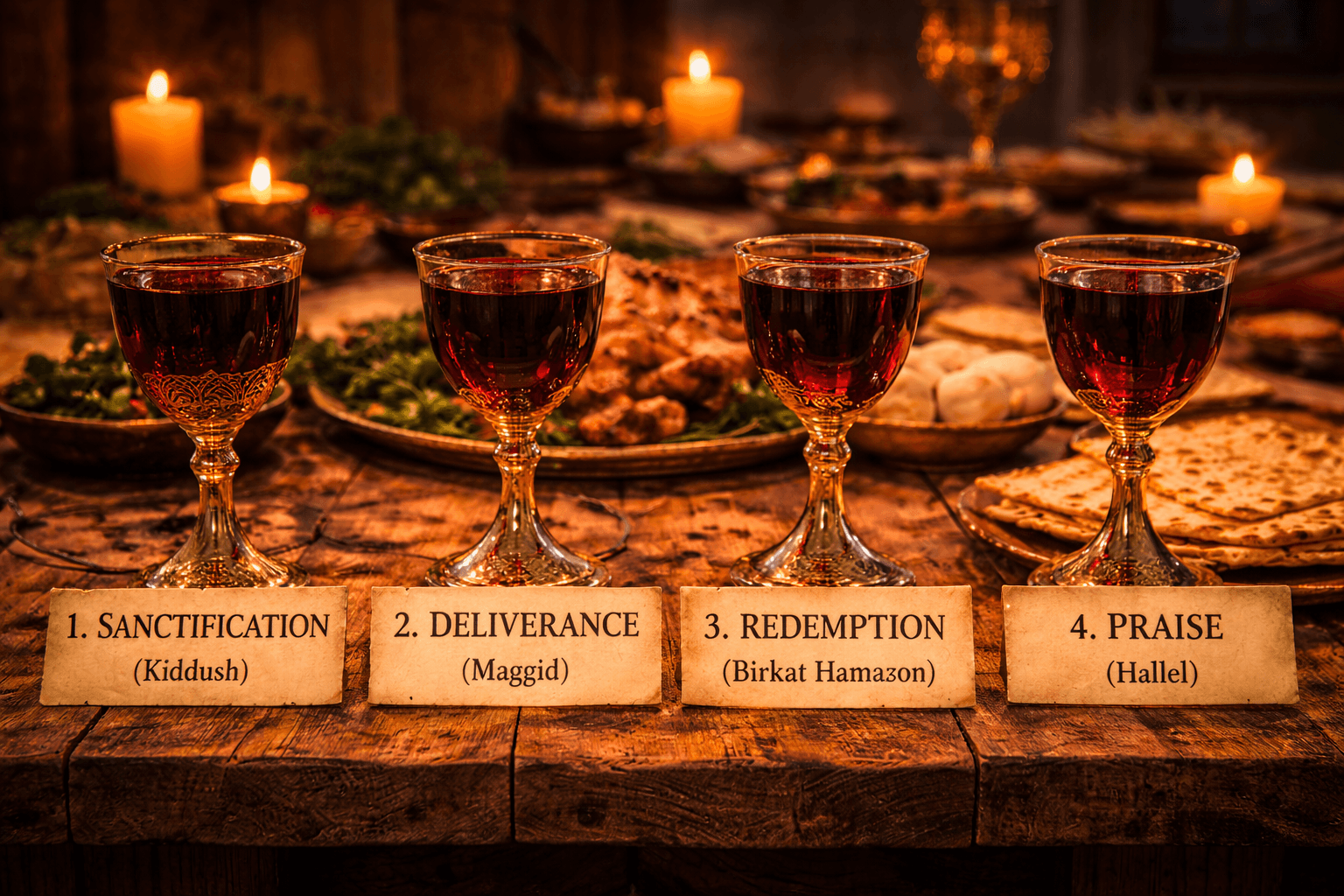
There were four specific promises (bolded below) that Jesus gave the Israelite that He would fulfill in Exodus 6:6–7.
Exodus 6:6–7 (ESV):
“Say therefore to the people of Israel, ‘I am the LORD, and I will bring you out from under the burdens of the Egyptians, and I will deliver you from slavery to them, and I will redeem you with an outstretched arm and with great acts of judgment. I will take you to be my people, and I will be your God, and you shall know that I am the LORD your God, who has brought you out from under the burdens of the Egyptians.’”
In later Jewish practice, each family drinks four cups of wine during the Passover feast to signify these four promises of God. The four cups are spaced throughout the evening in a set order that follows the flow of the Seder (a Passover Seder is a structured, 15-step interactive meal observed on the first one or two nights of Passover, designed to recount and relive the Israelites’ deliverance from slavery in Egypt).
1. First Cup – Sanctification (Kiddush)
This is drunk at the start of the meal. A blessing is recited over the wine to set the meal apart as holy, marking the beginning of Passover. This cup represents sanctification—being set apart as holy. The New Testament teaches that we are sanctified by Jesus through the Holy Spirit:
1 Corinthians 6:11 — “But you were washed, you were sanctified, you were justified in the name of the Lord Jesus Christ and by the Spirit of our God.”
2. Second Cup – Deliverance (Maggid)
After the opening rituals, the story of the Exodus is retold (fulfilling Exodus 13:8—“you shall tell your son…”). When this section is completed, the second cup of wine is drunk. Scripture shows that Jesus delivers us:
John 8:36 — “So if the Son sets you free, you will be free indeed.”
John 12:47 — “I did not come to judge the world but to save the world.”
Luke 4:18 — “The Spirit of the Lord is upon me… He has sent me to proclaim freedom for the captives and recovery of sight for the blind, to set at liberty those who are oppressed.”
Jesus fulfilled this.
3. Third Cup – Redemption (Birkat Hamazon)
After the main meal is eaten (which included the lamb in biblical times, along with unleavened bread per Exodus 12:8), prayers of thanksgiving are said, and then the third cup of wine is taken. This is the cup of the redemption.
Jesus has redeemed us. Redemption means that a price was paid to restore what was lost. This pattern is seen in the story of Hosea, where the husband redeems his unfaithful wife. In the same way, Jesus paid the price to redeem us:
Isaiah 44:22 — “I have blotted out your transgressions like a cloud and your sins like mist; return to me, for I have redeemed you.”
Isaiah 43:1 — “Fear not, for I have redeemed you; I have called you by name, you are mine.”
4. Fourth Cup – Praise (Hallel)
The evening concludes with songs of praise (traditionally Psalms 113–118), and then the fourth cup is drunk to complete the Seder.
As we consistently emphasize, the Old Testament laws and prophets all speak and point to Jesus. Jesus is the ONLY interpretation of the Old Testament commandments and prophecies.
The Last and Final Passover
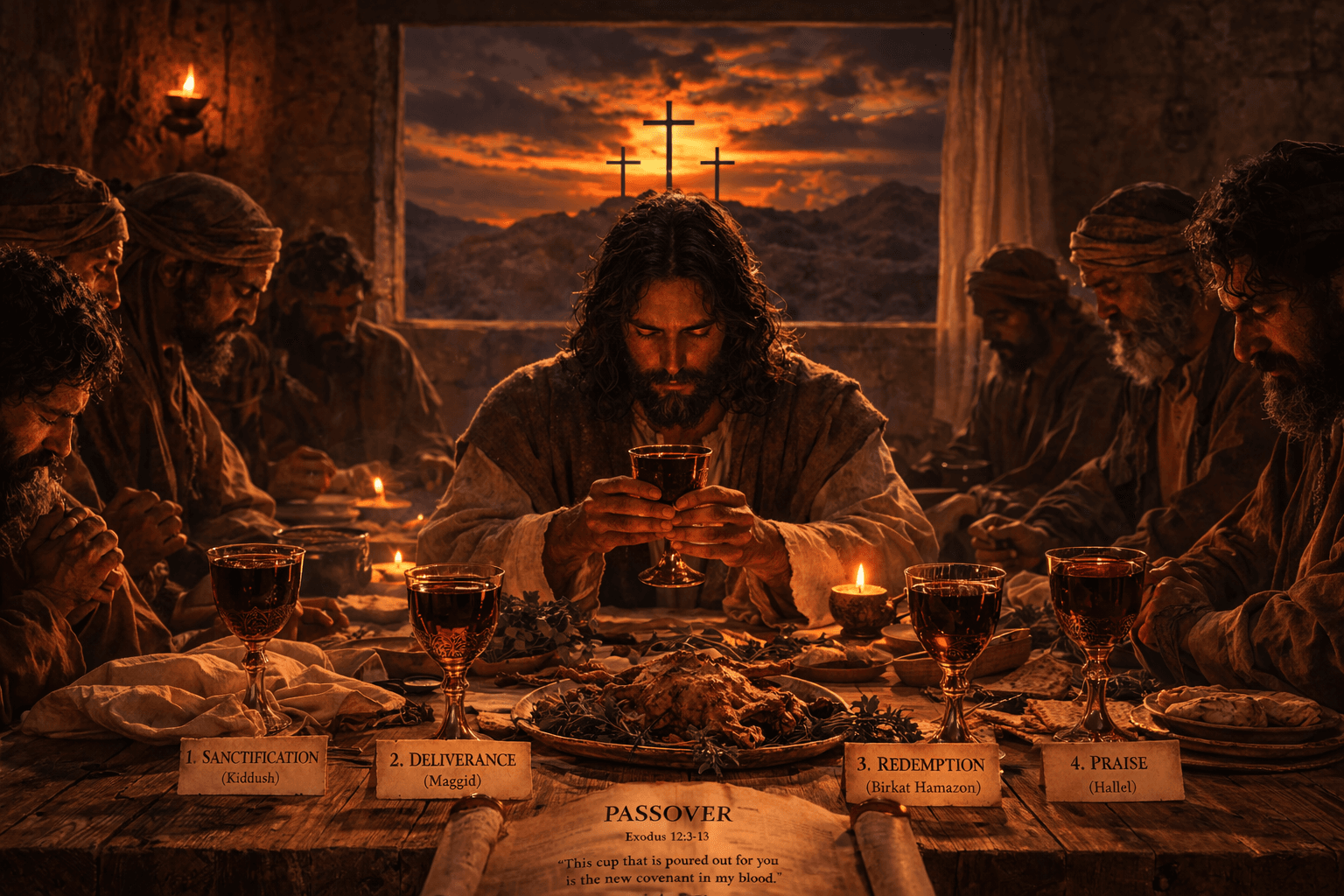
There are many details in this event that point directly to Jesus and His mission.
Luke 22:17–20 (ESV):
“17 And he took a cup, and when he had given thanks he said, ‘Take this, and divide it among yourselves.
18 For I tell you that from now on I will not drink of the fruit of the vine until the kingdom of God comes.’
19 And he took bread, and when he had given thanks, he broke it and gave it to them, saying, ‘This is my body, which is given for you. Do this in remembrance of me.’
20 And likewise the cup after they had eaten, saying, ‘This cup that is poured out for you is the new covenant in my blood.’”
The book of Luke gives us enough detail to trace where Jesus is within the Passover structure.
From the established order of the Seder:
Cup 1 (start) → storytelling → Cup 2 → meal → Cup 3 → praise → Cup 4
Step 1: A cup before the meal (Luke 22:17)
“And he took a cup…” This cup is taken before the bread, which places it before the meal. This aligns with the earlier portion of the Passover structure, specifically the second cup (Cup of Deliverance), which is associated with the retelling of the Exodus. They must have drank the first cup.
Step 2: The bread and meal (Luke 22:19)
“And he took bread…” This corresponds to the meal itself within the Passover.
Step 3: The cup after the meal (Luke 22:20)
“And likewise the cup after they had eaten…” This is explicit. This cup is taken after the meal, which directly aligns with the third cup (Cup of Redemption) in the Passover order. This is not assumed—Luke clearly anchors this cup after the meal, placing it in the position of the third cup.
And it is this third cup that He identifies as: “the new covenant in my blood”
This is critical. The cup that represents redemption is the one Jesus assigns to His blood. This directly connects His sacrifice to redemption—payment, restoration, and covenant. He redeemed us by shedding His Blood for us.
Ephesians 1:7 —
“In Him we have redemption through His blood, the forgiveness of our trespasses, according to the riches of His grace.”
The Missing Fourth Cup
After this moment, the Gospel account moves away from the meal. The fourth cup—the cup of praise—is not explicitly mentioned during the Last Supper.Instead, Jesus goes to the Mount of Olives, where He prays and is later arrested.This creates a gap in the Passover sequence.
John provides insight into the completion of this moment:
John 19:28–30 (ESV):
“28 After this, Jesus, knowing that all was now finished, said (to fulfill the Scripture), ‘I thirst.’ 29 A jar full of sour wine stood there, so they put a sponge full of the sour wine on a hyssop branch and held it to his mouth. 30 When Jesus had received the sour wine, he said, ‘It is finished,’ and he bowed his head and gave up his spirit.”
After completing His earthly mission, just before giving up His spirit, Jesus asked for a drink. John explicitly tells us this was done in fulfillment of Scripture (v. 28).
This suggests that the final cup—the cup of praise—may be connected to this moment. The sour wine offered to Him was still wine, and upon receiving it, He declared, “It is finished.”
This aligns with the completion of the four promises in Exodus 6:6–7. The final promise—“I will take you to be my people, and I will be your God”—is now fulfilled.
- I will bring you out from under the burdens of the Egyptians, (Sanctification)
- I will deliver you from slavery to them, (Deliverance)
- I will redeem you with an outstretched arm and with great acts of judgment. (Redemption)
- I will take you to be my people, and I will be your God…’” (Intimacy Restoration)
“It is finished.”
I pray that you see and receive this powerful revelation of what Jesus has done for us and embrace the rest He has provided.
Happy Easter.